|
Appliance Repair Tech School
Our school offers an extremely comprehensive
training program
that will give you the foundation that you need to start doing appliance
repair.
Appliance
Repair Tech School has culminated over
35 years
of Real Experience, having actually worked for Major Manufacturers,
as a Technician, and in Management. We provide a extremely, comprehensive,
technical training, that has been too long in the waiting, to take
the learning of appliance repair for prospective technicians, out
of the customer's home, and make them ready to provide the Best Possible
Appliance Repair for every customer, the moment they enter the customer's
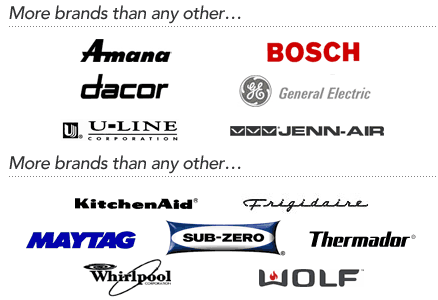
home, to service and repair all brands, of all their major appliances.
Our training sessions are not made up of just technical training,
like most training seminars you will find provided by others.
Our training sessions include technical, customer service, business
start-up assistance, and we do what nobody else does, Absolutely FREE,
by offering Unlimited Future assistance, for all attendees of the
Appliance Repair Tech School!
You will not find this additional future assistance,
anywhere in the world!
Appliance
Repair Tech School
participants will experience hands-on & classroom training
from an extremely experienced instructor,
with over 35 years of experience in the appliance
repair industry. The instructor has worked for Major Manufacturers
in the appliance repair industry, as a technician, as well as in Management.
The training sessions start with comprehensive basic electricity skills
and wiring diagram analysis, followed by troubleshooting, diagnosis,
disassembly, and repair of all brands of all major appliances.
All makes and models will be introduced to the attendees,
allowing for an extremely comprehensive understanding of appliance
repair.
• Real Customer, Hands-on, In-Home Repairs
• Basic Electricity Understanding
• Customer Service Skills
• Customer Confidence Skills
• Wiring Diagram/Schematics Analysis
• Troubleshooting/Repair
• Looking up parts/product breakdowns
• List of Required Tools for appliance repair
• Brazing/Soldering
• Manufacturer's Technical info
• Appliance Repair Tech School Certification
Outline of Appliance
Repair Tech School Training, for
Troubleshooting and Repair of Major Household Appliances
*All of
these subjects will be gone over in both 2 week and 3 week sessions.
Although, in the 2 week session, there will be brief overview
of most that are not directly pertinent to the repair and service
of major appliances. In the 2 week session, more emphasis will
be put on diagnosing and repairing major appliances, due to
the time constraint. Thus allowing you to go away with repair
and service knowledge that is the most effective for your time
spent at Appliance Repair Tech School. Whether you take the
2 week or 3 week sessions, you will walk away with a very good
foundation of knowledge about repairing appliances, that you
did not have before you arrived. In most cases, this will allow
you to go right out and start repairing and servicing appliances,
and have a great amount of confidence in what you are doing,
and also gain the confidence of the customer! Gaining the customer's
confidence, is the key to establishing a good working relationship
with them, and they will usually do your advertising for you,
by word of mouth, which beats any paid advertising, bar none!
Introduction
Basic Appliance Theory
What is inside an appliance?
Basic electrical principles
Voltage, current, and resistance
Ohm's Law
DC and AC
Series and parallel circuits
Appliance Troubleshooting
SAFETY
Safety myths
Safety guidelines
Should I unplug appliances when not
in use?
Troubleshooting tips
Basic hand tools
Soldering techniques
Desoldering techniques
Soldering pins in plastic connectors
Solderless connectors
Wire stripping
Attaching wires to screw terminals
Test equipment
Getting inside consumer appliances
Getting built up dust and dirt out
of appliances
Lubrication of appliances
Common appliance problems
Appliance cord gets hot
Extension cords
Internal wiring - cables and connectors
Switches - power, mode, or speed selection
Relays - electrically activated switches
for power or control
Contact configurations
Electrical overload protection devices
- fuses and circuit breakers
Fuse or circuit breaker replacement
Thermal protection devices - thermal
fuses and thermal switches
More on thermal fuses
Controls 1 - adjustable thermostats
Controls 2 - rheostats and potentiometers
Interlocks - prevent operation with
door open
Indicators - incandescent or neon light
bulbs or LEDs
Heating elements
Repair of broken heating elements
Solenoids - small and large
Small electronic components - resistors,
capacitors, diodes
Motors - AC, Induction, DC
Fans and Blowers - bladed or centrifugal
Bearings and bushings
Mechanical controllers - timing motors
and cam switches
Electronic controllers - simple delay
or microprocessor based
Convection oven noise
Dehumidifiers
Garbage disposals
Garbage disposal pops reset button
but nothing blocked
Garbage disposal is stuck - hums but
does not turn
Garbage disposal seizes repeatedly
Garbage disposal replacement (or upgrade)
Motor bearing problems
Motor noise
Finding a replacement motor
Major Appliances
Web sites for large appliance troubleshooting
Electric oven calibration
Heat control in electric range surface
units
Electric range top element does not
work properly
Range, oven, dryer electronic ignition
Replacing a thermostat
Oven door seal repair
Freezer is normal but fresh food compartment
isn't even cool
Refrigerator not cooling after a week
Defrost system operation and wiring
Compressor starting relays
Changing the temperature range of a
refrigerator
Washer sometimes spins
Clothes washer does not fill (cold
or hot)
Window air conditioner preventive maintenance
Window air conditioner doesn't cool
Air conditioner freezes up
Comments on electric clothes dryer
problems and repair
Dryer shuts down after a few minutes
Why has my dryer (or other high current)
plug/socket burned up?
Four year old gas dryer just started
popping GFCI
Checking dishwasher solenoids
Electrical Wiring Information and Problems
Safe electrical wiring
What is a GFCI?
GFCIs, overloads, and fire safety
How does a GFCI work
More on how the GFCI detects a N-G
short
GFCIs and safety ground
Where are 3 wire grounded outlets required?
Why you should NOT connect G to N
Testing installed GFCIs
Outlet wiring screwed up?
220 V outlet reads 0 VAC between slots
Why a GFCI should not be used with
major appliances
Comments on whole house surge suppressors
Determining electricity usage
Service Information
Wiring diagrams
Removing screw with stripped head
Mike's tips on improvised parts repair
Fixing stripped plastic threaded holes
Interchangeability of components
Appliance repair books
Large appliance repair manuals and
Web assistance
Manufacturer support
Parts suppliers
|
*Upon completion of the
Appliance Repair Tech School,
you will receive a Certification of Completion Certificate,
that is equivalent to all of the industry certifications,
and you will receive a Wall Certificate of Completion,
a Certification of Completion Wallet Card, and Unlimited assistance
from Appliance Repair Tech School, as long as you need it,
to help you succeed in the appliance repair industry.
The course will
then be wrapped up by introducing you
to the resources to get Certified by the EPA, for refrigerator
and air conditioning repair, involving freon.
You will also be introduced to the other certification programs,
Not required to work in the appliance
repair industry,
that some of the larger companies and corporations like to see.
One of these Certifications that is available,
is called the NASTeC
(National Appliance Service Technician Certification).
Appliance
Repair Tech School is Dedicated
to you SUCCEEDING, SUCCESSFULLY,
in the appliance repair industry!
After you leave
our school, each attendee will have access
to our web site Log-in Resources, to obtain useful technical
information we provide to assist you daily, with any
questions or problems you may have, about repairing an
appliance, as you run into problematic situations down the road.
...
The First, and Most Comprehensive Answer,
FINALLY...
for prospective appliance repair technicians! ...
Owner and Instructor,
Michael C Riley,
has over 35 years of experience in the appliance repair industry,
and is also the owner of The Top, 5 Star Rated Appliance Repair Company
in San Diego, according to online sources like,
Kudzu.com
and HomeAdvisor.com!
There is no price you can
put on the training
you will get at Appliance Repair Tech School!
The cost of our school
will be earned back
by you within weeks
of your fixing appliances in customer's homes!
SIGN UP for Appliance
Repair Tech School Today!

|
|